|
Bookshop > Trading and Capital-Markets Activities Manual > This page Trading and Capital-Markets Activities Manual Instrument
Profiles: Collateralized Loan Obligations (Continued) Transaction 2-High-Quality, Senior Risk Position in Reference Portfolio Is Retained In the second type of synthetic CLO transaction, the sponsoring banking organization hedges a portion of the reference portfolio and retains a high-quality, senior risk position that absorbs only those credit losses in excess of the junior-loss positions. For some noted synthetic CLOs, the sponsoring banking organization used a combination of credit-default swaps and CLNs to transfer to the capital markets the credit risk of a designated portfolio of the organization's credit exposures. Such a transaction allows the sponsoring banking organization to allocate economic capital more efficiently and to significantly reduce its regulatory capital requirements. In the structure illustrated in figure 2, the sponsoring banking organization purchases default protection from an SPV for a specifically identified portfolio of banking-book credit exposures, which may include letters of credit and loan commitments. The credit risk on the identified reference portfolio (which continues to remain in the sponsor's banking book) is transferred to the SPV through the use of credit-default swaps. In exchange for the credit protection, the sponsoring banking organization 6. The CLNs should not contain terms that would significantly limit the credit protection provided against the underlying reference assets, for example, a materiality threshold that requires a relatively high percentage of loss to occur before CLN payments are adversely affected, or a strucEagle Tradersg of CLN post-default payments that does not adequately pass through credit-related losses on the reference assets to investors in the CLNs. pays the SPV an annual fee. The default swaps on each of the obligors in the reference portfolio are structured to pay the average default losses on all senior unsecured obligations of defaulted borrowers. To support its guarantee, the SPV sells CLNs to investors and uses the cash proceeds to purchase U.S. government Treasury notes. The SPV then pledges the Treasuries to the sponsoring banking organization to cover any default losses.7 The CLNs are often issued in multiple tranches of differing seniority and in an aggregate amount that is significantly less than the notional amount of the reference portfolio. The amount of notes issued typically is set at a level sufficient to cover some multiple of expected losses, but well below the notional amount of the reference portfolio being hedged. There may be several levels of loss in this type of synthetic securitization. The first-loss position may consist of a small cash reserve, sufficient to cover expected losses. The cash reserve accumulates over a period of years and is funded from the excess of the SPV's income (that is, the yield on the Treasury securities plus the credit-default-swap fee) over the interest paid to investors on the notes. The investors in the SPV assume a second-loss position through their investment in the SPV's senior and junior notes, which tend to be rated AAA and BB, respectively. Finally, the sponsoring banking organization retains a high-quality, senior risk position that would absorb any credit losses in the reference portfolio that exceed the first- and second-loss positions. Typically, no default payments are made until the maturity of the overall transaction, regardless of when a reference obligor defaults. While operationally important to the sponsoring banking organization, this feature has the effect of ignoring the time value of money. Thus, the Federal Reserve expects that when the reference obligor defaults under the terms of the credit derivative and when the reference asset falls significantly in value, the sponsoring banking organization should, in accordance with generally accepted accounting principles, make appropriate adjustments in its regulatory reports to reflect the estimated loss that takes into account the time value of money. For risk-based capital purposes, the banking organizations investing in the notes must assign them to the risk weight appropriate to the underlying reference assets.8 The sponsoring banking organization must include in its risk-weighted assets its retained senior exposure in the reference portfolio, to the extent these underlying assets are held in its banking book. The portion of the reference portfolio that is collateralized by the pledged Treasury securities may be assigned a zero percent risk weight. Unless the sponsoring banking organization meets the stringent minimum conditions for transaction 2 as outlined in the subsection ''Minimum Conditions'' (below), the remainder of the portfolio should be risk weighted according to the obligor of the exposures. When the sponsoring banking organization has virtually eliminated its credit-risk exposure to the reference portfolio through the issuance of CLNs, and when the other minimum requirements are met, the sponsoring banking organization may assign the uncollateralized portion of its retained senior position in the reference portfolio to the 20 percent risk weight. However, to the extent that the reference portfolio includes loans and other on-balance-sheet assets, the sponsoring banking organization would not realize any benefits in the determination of its leverage ratio. In addition to the three stringent minimum conditions, the Federal Reserve may impose other requirements as it deems necessary to ensure that a sponsoring banking organization has virtually eliminated all of its credit exposure. Furthermore, the Federal Reserve retains the discretion to increase the risk-based capital requirement assessed against the retained senior exposure in these structures if the underlying asset pool deteriorates significantly. Federal Reserve staff will make a case-by-case determination, based on a qualitative review, as to whether the senior retained portion of a sponsoring banking organization's synthetic securitization qualifies for the 20 percent risk weight. The sponsoring banking organization must be able to demonstrate that virtually all the credit risk of the reference portfolio has been transferred from the banking book to the capital markets. As they do when banking organizations are engaging in more traditional securitization activities, examiners must carefully evaluate whether the sponsoring banking organization is fully capable of assessing the credit risk it retains in its banking book and whether it is adequately capitalized given its residual risk exposure. 7. The names of corporate obligors included
in the reference portfolio may be disclosed to investors in the CLNs. The Federal Reserve will require the sponsoring banking organization to maintain higher levels of capital if it is not deemed to be adequately capitalized given the retained residual risks. In addition, a sponsoring banking organization involved in synthetic securitizations must adequately disclose to the marketplace the effect of its transactions on its risk profile and capital adequacy. The Federal Reserve may consider a sponsoring banking organization's failure to require the investors in the CLNs to absorb the credit losses that they contractually agreed to assume to be an unsafe and unsound banking practice. In addition, such a failure generally would constitute ''implicit recourse'' or support to the transaction, which results in the sponsoring banking organization's losing preferential capital treatment on its retained senior position. If a sponsoring banking organization of a synthetic securitization does not meet the stringent minimum conditions, it may still reduce the risk-based capital requirement on the senior risk position retained in the banking book by transferring the remaining credit risk to a third-party OECD bank through the use of a credit derivative. Provided the credit-derivative transaction qualifies as a guarantee under the risk-based capital guidelines, the risk weight on the senior position may be reduced from 100 percent to 20 percent. Sponsoring banking organizations may not enter into non-substantive transactions that transfer banking-book items into the trading account to obtain lower regulatory capital requirements.9 9. For instance, a lower risk weight would not be applied to a non-substantive transaction in which the sponsoring banking organization (1) enters into a credit-derivative transaction to pass the credit risk of the senior retained portion held in its banking book to an OECD bank, and then (2) enters into a second credit-derivative transaction with the same OECD bank, in which it reassumes into its trading account the credit risk initially transferred. Minimum Conditions The following stringent minimum conditions are those that the sponsoring banking organizations must meet to use the synthetic securitization capital treatment for transaction 2. The Federal Reserve may impose additional requirements or conditions as deemed necessary to ascertain that a sponsoring banking organization has sufficiently isolated itself from the credit-risk exposure of the hedged reference portfolio. Condition 1-Demonstration of transfer of virtually all the risk to third parties. Not all transactions structured as synthetic securitizations transfer the level of credit risk needed to receive the 20 percent risk weight on the retained senior position. To demonstrate that a transfer of virtually all of the risk has been achieved, sponsoring banking organizations must- • produce credible analyses indicating
a transfer of virtually all the credit risk to substantive third parties; 10. Early-amortization clauses may
generally be defined as features that are designed to force a wind-down
of a securitization program and rapid repayment of principal to asset-backed
securities investors if the credit quality of the underlying asset pool
deteriorates significantly. Condition 2-Demonstration of ability to evaluate remaining banking-book risk exposures and provide adequate capital support. To ensure that the sponsoring banking organization has adequate capital for the credit risk of its un-hedged exposures, it is expected to have adequate systems that fully account for the effect of these transactions on its risk profiles and capital adequacy. In particular, the sponsoring banking organization's systems should be capable of fully differentiating the nature and quality of the risk exposures it transfers from the nature and quality of the risk exposures it retains. Specifically, to gain capital relief sponsoring banking organizations are expected to- • have a credible internal process
for grading credit-risk exposures, including the following: • perform rigorous and robust forward-looking stress testing on non-transferred exposures (remaining banking-book loans and commitments), transferred exposures, and exposures retained to facilitate transfers (credit enhancements). The stress tests must demonstrate that the level of credit enhancement is sufficient to protect the sponsoring banking organization from losses under scenarios appropriate to the specific transaction. Condition 3-Provide adequate public disclosures of synthetic CLO transactions regarding their risk profile and capital adequacy. In their 10-K and annual reports, sponsoring banking organizations must adequately disclose to the marketplace the accounting, economic, and regulatory consequences of synthetic CLO transactions. In particular, sponsoring banking organizations are expected to disclose- • the notional amount of loans and
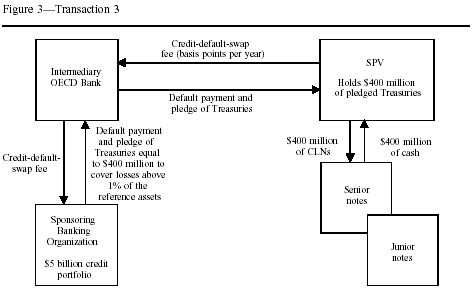
commitments involved in the transaction; Transaction 3-First-Loss Position Is Retained In the third type of synthetic transaction, the sponsoring banking organization may retain a subordinated position that absorbs the credit risk associated with a first loss in a reference portfolio. Furthermore, through the use of credit-default swaps, the sponsoring banking organization may pass the second- and senior-loss positions to a third-party entity, most often an OECD bank. The third-party entity, acting as an intermediary, enters into offsetting credit-default swaps with an SPV, thus transferring its credit risk associated with the second-loss position to the SPV.11 The SPV then issues CLNs to the capital markets for a portion of the reference 11. Because the credit risk of the senior position is not transferred to the capital markets but remains with the intermediary bank, the sponsoring banking organization should ensure that its counterparty is of high credit quality, for example, at least investment grade.
portfolio and purchases Treasury collateral to cover some multiple of expected losses on the underlying exposures. Two alternative approaches could be used to determine how the sponsoring banking organization should treat the overall transaction for risk-based capital purposes. The first approach employs an analogy to the low-level-capital rule for assets sold with recourse. Under this rule, a transfer of assets with recourse that contractually is limited to an amount less than the effective risk-based capital requirements for the transferred assets is assessed a total capital charge equal to the maximum amount of loss possible under the recourse obligation. If this rule applied to a sponsoring banking organization retaining a 1 percent first-loss position on a synthetically securitized portfolio that would otherwise be assessed 8 percent capital, the sponsoring banking organization would be required to hold dollar-for-dollar capital against the 1 percent first-loss risk position. The sponsoring banking organization would not be assessed a capital charge against the second- and senior-risk positions.12 The second approach employs a literal reading of the capital guidelines to determine the sponsoring banking organization's risk-based capital charge. In this instance, the 1 percent first-loss position retained by the sponsoring banking organization would be treated as a guarantee, that is, a direct credit substitute, which would be assessed an 8 percent capital charge against its face value of 1 percent. The second-loss position, which is collateralized by Treasury securities, would be viewed as fully collateralized and subject to a zero percent capital charge. The senior-loss position guaranteed by the intermediary bank would be assigned to the 20 percent risk category appropriate to claims guaranteed by OECD banks.13 The second approach may result in a higher risk-based capital requirement than the dollar-for-dollar capital charge imposed by the first approach, depending on whether the reference portfolio consists primarily of loans to private obligors or undrawn long-term commitments. The latter generally have an effective risk-based capital requirement one-half of the requirement for loans because these commitments are converted to an on-balance-sheet credit-equivalent amount using the 50 percent conversion factor. If the reference pool consists primarily of drawn loans to private obligors, then the capital requirement on the senior-loss position would be significantly higher than if the reference portfolio contained only undrawn long-term commitments. As a result, the capital charge for the overall transaction could be greater than the dollar-for-dollar capital requirement set forth in the first approach. Sponsoring banking organizations will be required to hold capital against a retained first-loss position in a synthetic securitization equal to the higher of the two capital charges resulting from application of the first and second approaches, as discussed above. Further, although the sponsoring banking organization retains only the credit risk associated with the first-loss position, it still should continue to monitor all the underlying credit exposures of the reference portfolio to detect any changes in the credit-risk profile of the counterparties. This is important to ensure that the sponsoring banking organization has adequate capital to protect against unexpected losses. Examiners should determine whether the sponsoring banking organization has the capability to assess and manage the retained risk in its credit portfolio after the synthetic securitization is completed. For risk-based capital purposes, banking organizations investing in the notes must assign them to the risk weight appropriate to the underlying reference assets.14 12. The sponsoring banking organization
would not realize any benefits in the determination of its leverage ratio
since the reference assets remain on its balance sheet. LEGAL LIMITATIONS FOR BANK INVESTMENTS Asset-backed securities can be either type IV or type V securities. Type IV securities include the following asset-backed securities that are fully secured by interests in a pool (or pools) of loans made to numerous obligors: • investment-grade residential-mortgage-related
securities offered or sold pursuant to section 4(5) of the Securities
Act of 1933 (15 USC 77d(5)) Type V securities consist of all asset-backed securities that are not type IV securities. Specifically, they are defined as marketable, investment-grade-rated securities that are not type IV and are ''fully secured by interests in a pool of loans to numerous obligors and in which a national bank could invest directly.'' CLOs and synthetic securitizations are generally classified as type V securities. A bank may purchase or sell type V securities for its own account provided the aggregate par value of type V securities issued by any one issuer held by the bank does not exceed 25 percent of the bank's capital and surplus. REFERENCES Board of Governors of the Federal Reserve
System. SR-96-17, ''Supervisory Guidance for Credit Derivatives.'' August
12, 1996. Continue to COMMODITY-LINKED TRANSACTIONS Back to Activities Manual Index |